
The aim of Resilient Schools is to strengthen the social and emotional foundations children need to thrive in learning and life.
A practical, concept-based approach that engages early learning centres in nurturing every child's emotional well-being and resilience from the earliest stage of life.
Supporting Children's social and emotional development has never been more important!
Resilient Schools focuses on the unseen skills of learning, thinking, emotions, behaviours and attitudes.
This new of engaging shapes how children respond to challenge and every experience they have.
Educators support emotional regulation, behaviour, and social development, sometimes without clear, practical tools that fit into everyday learning.
What if we started intentionally teaching children the skills of...
Confidence
Wellbeing
Connection
Resilience
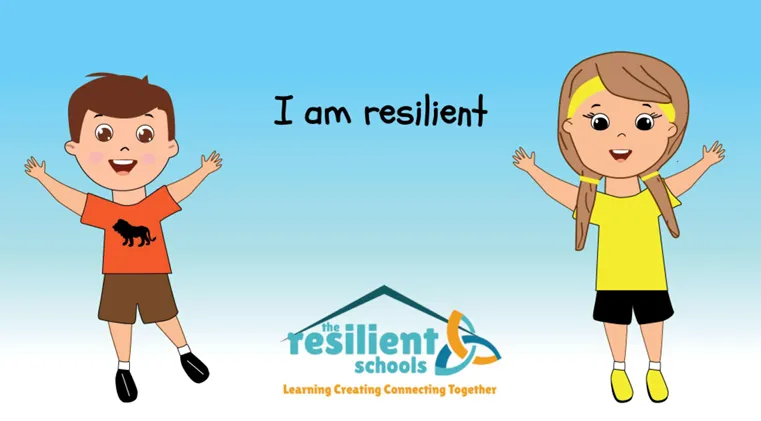
Resilience begins in the early years through connecting with the childrens:
Identity
Developing self-awareness through personal strengths
Emotional Awareness
Every interaction shapes how a child feels and responds.
Classroom participation
Active Engagement in and with learning
Relationships
Connecting through friendships and social engagement
Empathy & Kindness
Caring & Helping Others
Community & Belonging
Feeling connected and part of a group
A child stands quietly at the gate.
An educator kneels beside them and says,
“You can stand with me until you’re ready.”
In that moment, the child feels
Safe.
Seen.
Like they belong.
This is what a resilient school looks like.

A simple and effective practical approach
1. Digital story and interactive-based learning
Introduces early learning concepts through engaging and relatable experiences. The program consists of engaging digital stories, memorable songs and printable resources to support deep learning.
2. Intentional teaching
Intentionally teaching and actively checking for understanding of the concept.
3. Play-based learning
Supporting children to understand and apply the concept meaningfully in everyday interactions through play.
4. Reinforced through intentional everyday moments
Children build confidence through repetition and real-life interactions.
5. Curriculum aligned
This program purposefully aligns with the Early Years Learning Framework and ACARA Personal and Social Capabilities.
6. Parent engagement pack
An easy guide for parents to support learning at home, which promotes early childhood centres communication with parents.
Resilient Schools promotes the foundation for early childhood social and emotional development through:
Explicit, step-by-step interactive activities
A Teacher handbook that guides teaching implementation and supports social and emotional learning
Storybooks, songs and hands-on learning
Fun and engaging ways of learning
What this creates for your centre is:
Children who feel safe, seen, and supported
Stronger emotional regulation and confidence
A shared understanding of early learning concepts
A shared language around identity, emotions, relationships and community
A culture of confident, resilient and empowered learners
A calmer, more connected learning environment
A strong alignment with the Early Years Learning Framework and ACARA Personal and Social Capabilities.
Based on research, experience, and proven practice
Resilient Schools is grounded in contemporary neuroscience, developmental psychology, and educational research. It draws on over 20 years of experience in early childhood education to create a practical, evidence-informed approach that is connected to the Early Years Learning Framework and ACARA's Personal and Social Capabilities.
Informed by research in emotional development and behaviour
Focused on prevention, not just responding to challenges
Designed for real-world implementation in early learning settings
Article Seven: The Legacy The Leader You Leave Behind
INSIDE-OUT LEADERSHIP SERIES
Exploring the connection between neuroscience, The Inner Self, the ripple and legacy we create through everyday leadership.
Article Seven: The Legacy
The Leader You Leave Behind
"Leadership is not remembered for the position we held. It is remembered for the lives we shaped."
Every leadership journey eventually arrives at a question that cannot be answered by organisational charts, strategic plans or performance measures. It is a question that shifts our attention away from what we have achieved and towards the influence we have had on the people around us. Long after projects have been completed, positions have changed and organisations have evolved, what remains? This question sits at the heart of legacy because leadership is rarely remembered for titles or accomplishments alone. Instead, it is remembered through the experiences people carry with them, the confidence they discovered, the opportunities they were given and the relationships that shaped their lives. While organisations often measure success through outcomes, people remember leadership through human experience.
Throughout this series I have explored leadership as an inside-out process. We began by recognising that leadership starts long before our behaviour becomes visible. The Inner Self reflecting our thoughts, beliefs, emotions, values, identity, purpose, lived experiences and nervous system, which influences the way we perceive situations, interpret challenges and respond to others. From there we explored the role of self-awareness as the bridge between understanding ourselves and intentionally leading ourselves. Self-leadership then emerged as the ongoing practice of consciously regulating our thinking, emotions and behaviour so that our leadership becomes increasingly aligned with our values and purpose. Finally, we considered the ripple created through every interaction, recognising that leadership continually extends beyond the individual into relationships, teams, children, families and communities.
The final stage of The Inside-Out Leadership Framework is not another skill to master or another competency to develop. Rather, it is the natural consequence of everything that has come before. Legacy is not something that begins at the end of a career or is reserved for exceptional leaders. Legacy is created every day through the countless interactions that quietly shape the lives of others. Every conversation, every decision, every moment of encouragement and every act of kindness contributes to the story another person carries forward. In many respects, the legacy we leave is simply the accumulation of the ripples we create throughout our lives.
The Journey of Inside-Out Leadership
Leadership begins within. The ripple changes everything. The legacy lives on.

The journey illustrated in Figure 1 demonstrates that leadership is not a collection of isolated ideas but a connected process of human development. Leadership begins with understanding ourselves. It develops through awareness and intentional self-leadership before becoming visible in the way we influence others. Those interactions create ripples across relationships, organisations and communities that continue long after the original moment has passed. Over time, these ripples become the legacy we leave behind. Rather than representing separate stages, each element builds upon the one before it, reinforcing the idea that lasting leadership is always grounded in who we become before it is expressed through what we do.
One of the greatest misconceptions about leadership is that legacy is created through extraordinary achievements. While history often remembers remarkable leaders, the influence that shapes our everyday lives is usually far more ordinary. Most people do not remember a leader because they delivered a strategic plan or achieved a performance target. They remember the person who listened when they needed to be heard. They remember the teacher who believed in them or how they made them feel when life was challenging. They remember the colleague who remained calm during uncertainty or the mentor who encouraged them to take a step they never thought possible. These moments rarely attract public recognition, yet they often become the experiences people carry with them for decades. Legacy is not built through isolated moments of greatness. It is built through the consistent practice of intentional leadership in ordinary moments.
This understanding shifts the way we think about influence. Leadership is often associated with authority, yet genuine influence extends far beyond formal roles. Every educator influences children who will one day become parents, professionals and community leaders. Every team leader shapes the confidence, wellbeing and leadership capacity of those they work alongside. Every conversation contributes to the culture people experience, and culture, in turn, influences the way individuals think, behave and relate to others. The ripple continues through relationships we may never witness and into futures we may never see. Leadership therefore becomes less about directing others and more about creating conditions in which other people are able to flourish.
Within the Inside-Out Leadership Framework, this perspective places character at the centre of legacy. Before we influence another person, we are continually shaping ourselves. Our values influence our decisions. Our beliefs shape our expectations. Our emotions affect the way we communicate. Our purpose guides the choices we make every day. The legacy we create is therefore inseparable from the person we become. This is why leadership begins within. External influence is simply the visible expression of an internal process that has been developing long before anyone else notices it.
Perhaps the most humbling aspect of leadership is that we rarely see the full extent of our influence. We may never know that a conversation gave someone the confidence to apply for a leadership role. We may never hear that a child remembered our encouragement years later when facing a difficult decision. We may never discover that our calmness during a challenging situation became someone else's model for leadership. Yet this uncertainty does not diminish the importance of our actions. Instead, it reminds us that leadership requires faith in the value of investing in people. The ripples continue regardless of whether we witness them, and often the greatest influence occurs beyond our awareness.
This understanding invites us to reconsider the way we define success. Contemporary leadership often asks how effectively we achieved organisational goals or improved performance. While these questions remain important, Inside-Out Leadership encourages another question that may be even more significant: Who is stronger because I was here? This question redirects our attention from personal achievement towards collective growth. Success becomes less about individual recognition and more about the environments we create, the confidence we nurture and the leadership we inspire in others. Leadership becomes an act of stewardship rather than status, recognising that our greatest contribution may be the leaders we help develop rather than the accomplishments we achieve ourselves.
As this series comes to a close, I find myself returning to the same idea with which it began. Leadership is fundamentally a human process. It begins within the individual, grows through intentional self-awareness and self-leadership, becomes visible in relationships and creates ripples that extend into teams, organisations, families and communities. Over time, those ripples become the legacy we leave behind. The true measure of leadership is therefore not the title on our business card or the achievements listed on our résumé. It is the positive influence that continues because our lives intersected with the lives of others.
Perhaps that is the greatest invitation of Inside-Out Leadership. It asks us not simply to become more effective leaders, but to become the kind of people whose influence continues to strengthen others long after we are gone. Titles will change. Organisations will evolve. Achievements will eventually be forgotten. But the confidence we nurtured, the hope we inspired and the leaders we helped develop may continue shaping the future in ways we will never fully understand.
That is the enduring power of intentional leadership.
That is the legacy we leave behind.
Continue the Conversation
This concludes the Inside-Out Leadership Series.
Thank you for walking this journey with me. My hope is that these articles have encouraged you to see leadership not simply as something we do, but as someone we continually become.
What kind of legacy do you hope your leadership will leave?
Leadership begins within.
The ripple changes everything.
The legacy lives on.
© 2026 Lynne Kendall. All rights reserved.
Inside-Out Leadership is the original leadership framework developed by Lynne Kendall. This article forms part of the Inside-Out Leadership Series, exploring how neuroscience, psychology, education and reflective practice deepen our understanding of self-awareness, self-leadership and the ripple effects of intentional leadership.

Empower every child to thrive in a resilient learning environment for now and in the future..
Create a culture of confident, resilient and connected learners today.
Partner today with Resilient Schools
Shaping resilient, connected learning communities from the early years
© The Resilient Schools
[email protected]
www.theresilientreader.com.au
Privacy Policy | Terms & Conditions

